Bugatti’s fifth victory at the Targa Florio
Although it hasn’t been held since the late 1970s, the Targa Florio is still known to many racing fans today. For the first time it was held in 1906, when the entrepreneur Vincenzo Florio decided to organize his own car race on the streets of his family in the Madonie region of Sicily. It wasn’t a simple, four-kilometer circuit, as one might expect today. Instead, originally one lap was over 148 kilometers long. The first race saw the arrival of ten vehicles, which were dispatched every ten minutes. After 9 hours and 32 minutes the winner crossed the finish line. In 1919, the organizers shortened the lap to 108 kilometers, in 1932 again to just 72 kilometers. Nevertheless, the Targa Florio was considered one of the most demanding races in the world and therefore challenged several manufacturers to bring their best drivers and cars to the startline. From time to time it even received the status of a World Championship race for sports car racing. Starting in 1978, the event was converted into a rally with shorter special stages along the original route.
In the 1920s, more and more Bugatti racing cars came along. Next to private drivers also the factory team joined in and first won the race in 1925 with a Type 35 and the Italian driver Bartolomeo Costantini at the wheel. He also won in the following year, this time with a Type 35T. In 1927 Emilio Materassi drove a Type 35C to victory and in 1928 Albert Divo crossed the finish line first with a Type 35B. Finally, the ‘Usines Bugatti’, as the factory team was officially called, made history in 1929 when they took the victory for the fifth time in a row, again with Albert Divo at the wheel of a Type 35C. It was the first and only time in the history of this race that the same team won five times. A quite remarkable achievement, after all, as the 108-kilometer course had more than 1,400 corners and slope sections, which hardly any driver could memorize. The race back then went over five laps, so about 540 kilometers of total distance. In contrast to today’s closed race tracks with clinically clean asphalt, the often narrow mountain roads of the Targa Florio still showed their original gravel surface and were anything but free. Behind every tight corner, donkey carts or herds of cattle could lurk on the road. Especially during the training days, which were advertised in the weeks before the event, there was normal traffic out on the streets even until the 1970s. The participants had to work their way through.


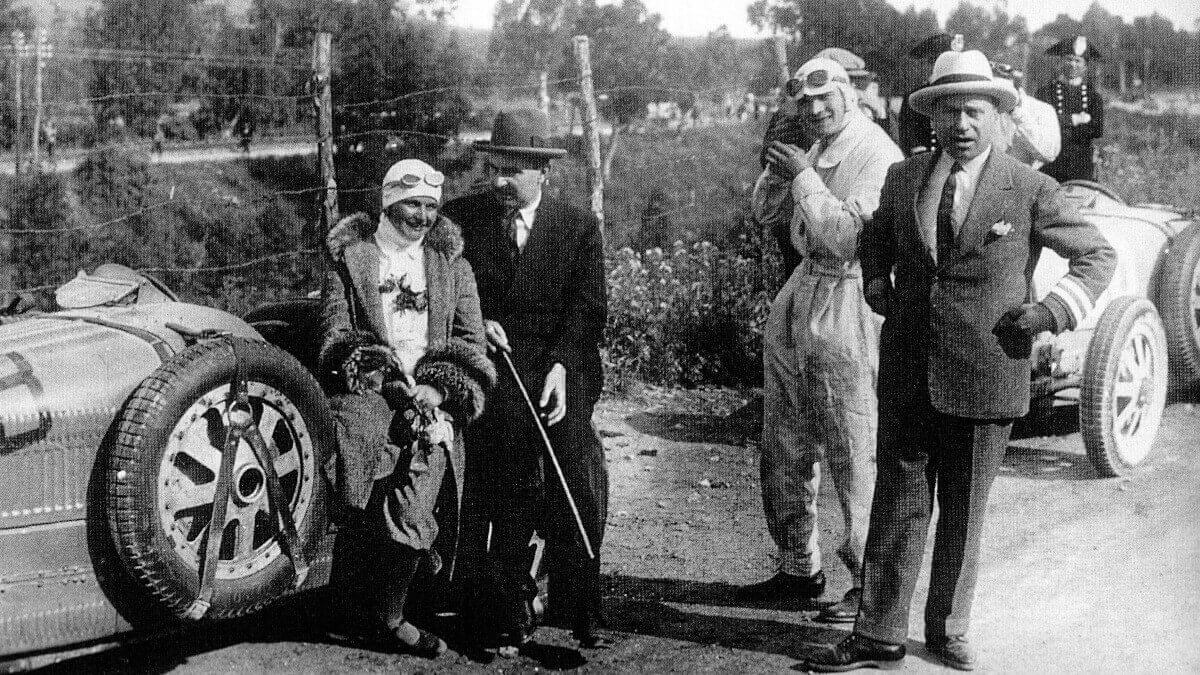
The teams were able to carry out refueling and tire changes along the entire route, for which they set up their own spare parts and fuel depots along the track. Any driver change, however, could only be performed under the supervision of a race director in the start-finish area at Cerda station. From there, the route snaked through the village of Caltavuturo via Madonie and Polizzi to an altitude of over 900 meters, than to Collesano and Campofelice and back along the coast over a six-kilometer straight to Cerda station. In 1929, eight out of the 29 participants entered the race in a Bugatti. From the start, Albert Divo and his team-mate Ferdinando Minoia dominated the action. Their cars with an approximately 125 hp strong supercharged eight-cylinder engine and a curb weight of only 750 kilograms allowed a topspeed of over 200 kph (124 mph) on the straights. Bugatti was well-known for consistent lightweight constructions and therefore made the engine and gearbox housings as well as the wheels from magnesium and forged a hollow front axle.
Of the 29 cars that started into the race, only seven reached the end. They were started every three minutes. Minoia set a new lap record with a time of 1:25 hours and an average speed of 75.98 kph (47.21 mph), but ultimately couldn’t win the race because of a puncture. Again Albert Divo won with a total time of 7:15:41.7 hours, which was a full 35 minutes faster than his victory time a year earlier. His average speed over the full distance was 74.4 kph (46.23 mph). In the present time, Bugatti is developing a new supercar named after Albert Divo, which debuted last year at Pebble Beach. All 40 copies, offered at a base price of five million euros, were already sold out before the world premiere took place. First customers will receive their cars later this year.
Images: Bugatti