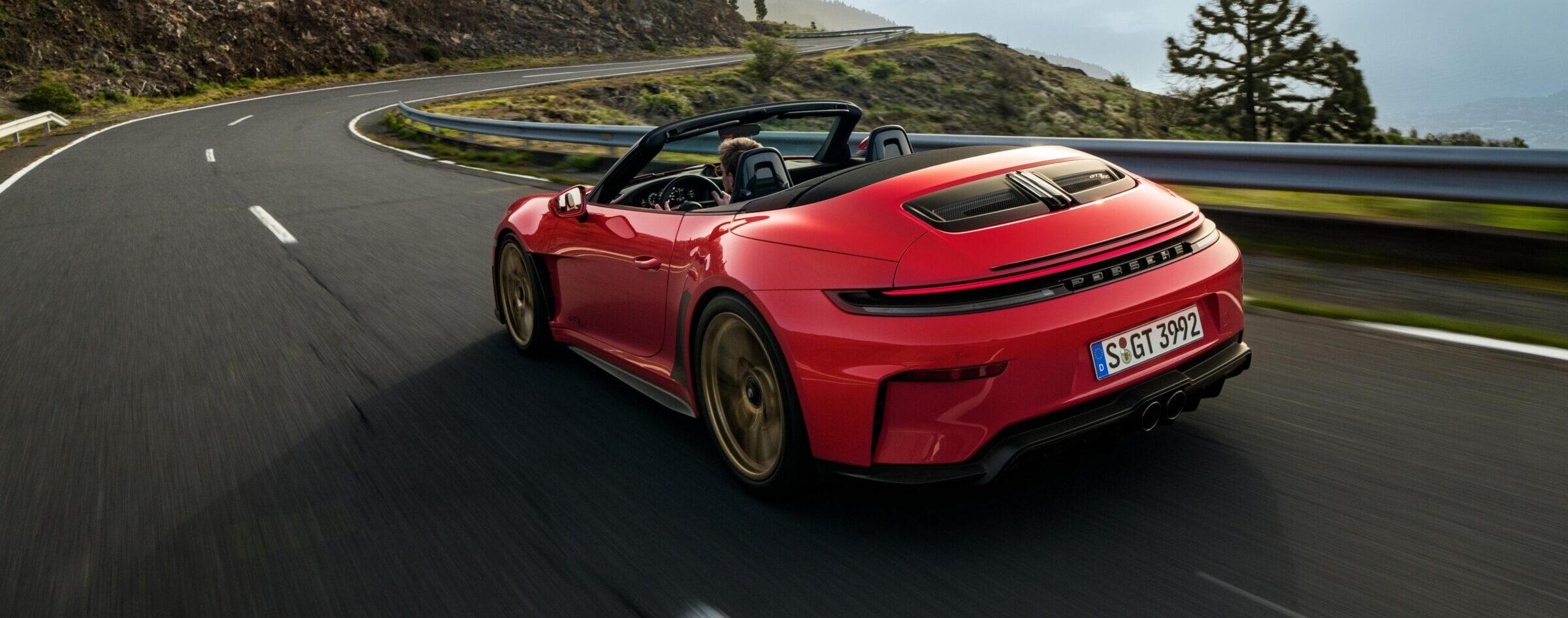
The sky opens up over Weissach – 911 GT3 S/C
It’s early morning, somewhere between a test track and ideology. The asphalt is still steaming slightly, as if it doesn’t quite understand why it’s becoming a stage today. Then that sound: no turbo, no synthetic soundscape—just mechanical determination. A six-cylinder engine breathing freely, making no apologies. And above it: nothing. No roof. No filter. Just air.
Porsche calls the result the Porsche 911 GT3 S/C. You could also say it’s a contradiction on wheels.
An open-top GT3? For a long time, that was considered sacrilege. The GT3 has always been the last refuge for purists—for those torn between a track day at Spa and a sunrise drive up the Großglockner. A roof? Weight. Comfort? Suspicion. And now, a convertible. Lightweight construction, mind you—at least according to the press release.
Technically, they’ve stayed true to themselves: the familiar 4.0-liter naturally aspirated engine, further refined with sharper camshafts from the RS lineup, optimized peripherals, and an impressive 510 hp. Add to that a short-ratio 6-speed manual transmission—a detail that seems almost defiant in a world long dominated by dual-clutch transmissions. And yes: exhaust aftertreatment has become more complex. Four catalytic converters, two particulate filters—the full range of modern technology. That Porsche still speaks of an “emotional soundscape” is either a minor miracle of engineering or a very well-written piece of marketing. We’re betting on the former.


The real trick of this car, however, lies not in the numbers, but in the concept. Because an open-top GT3 is a deliberate provocation. While the classic GT3 was increasingly optimized as a track tool, the S/C strikes a different note: less lap time, more experience. The roof comes down—and with it, a bit of dogmatic seriousness. Suddenly, it’s no longer just about the ideal line, but about sounds, smells, and speed as a sensory experience. Porsche doesn’t put it that way, but between the lines it says: This GT3 isn’t made for the pit lane, but for the moment in between.
And this is where the real story begins. For while Porsche presents the GT3 S/C as a particularly purist model, it is at the same time a product of maximum complexity: highly advanced exhaust gas treatment, finely tuned aerodynamics, and extreme material optimization. Purity is no longer a starting point here—it is the result of enormous technical effort. Or to put it another way: The “purist” GT3 is today a highly complex compromise. That’s not a bad thing. But it is remarkable.
The classic GT3 driver? Helmet, gloves, a Nordschleife annual pass. The GT3 S/C appeals to a different audience: people who know what 9,000 rpm feels like—but also what a sunrise on an empty country road sounds like. It’s less of a tool and more of an experience machine. Less “faster than yesterday,” more “more intense than anything else.”
The Porsche 911 GT3 S/C represents a cultural shift. It is an attempt to reinterpret the GT3 legend without completely abandoning it. One could view this critically: as a watering down of an icon, as a concession to a wealthy clientele that likes to appear purist but doesn’t want to sacrifice comfort. Or one could see in it exactly what has distinguished Porsche for decades: the ability to make contradictions drivable. An open-top GT3 remains a paradox. But perhaps that is precisely why it is so appealing.
Porsche 911 GT3 S/C
Engine: 4.0L 6-cylinder natural aspirated (boxer)
Power: 375 kW (510 PS) @ 8,400 rpm
Weight: ca. 1,420 kg (DIN, lightweight concept)
Gearbox: manual 6-speed
Accleration: 0–100 km/h in ca. 3.9 s
Vmax: max. 311 km/h
Price: from 269000€
Photos: Porsche AG