Following in the footsteps of Formula 1 with the Lotus Emira Type 86.
The year is 1980. Colin Chapman and Martin Wright are working on a new concept for Lotus in Formula 1 that pushes the limits of the regulations. Wing cars were officially banned at that time. The regulations required that all aerodynamic parts be firmly attached to the chassis. However, it was unclear whether “chassis” referred to the singular or plural. Chapman saw this as an opportunity and developed a race car with two interlocking chassis parts, each with independent suspension. This allowed one part to take care of aerodynamics and cooling, while the other chassis accommodated the driver, engine, transmission, and suspension—a double chassis that was technically completely new. The result was a car that broke new technical ground, but was challenged by Ferrari and Williams during its planned deployment in Rio de Janeiro and subsequently disqualified.
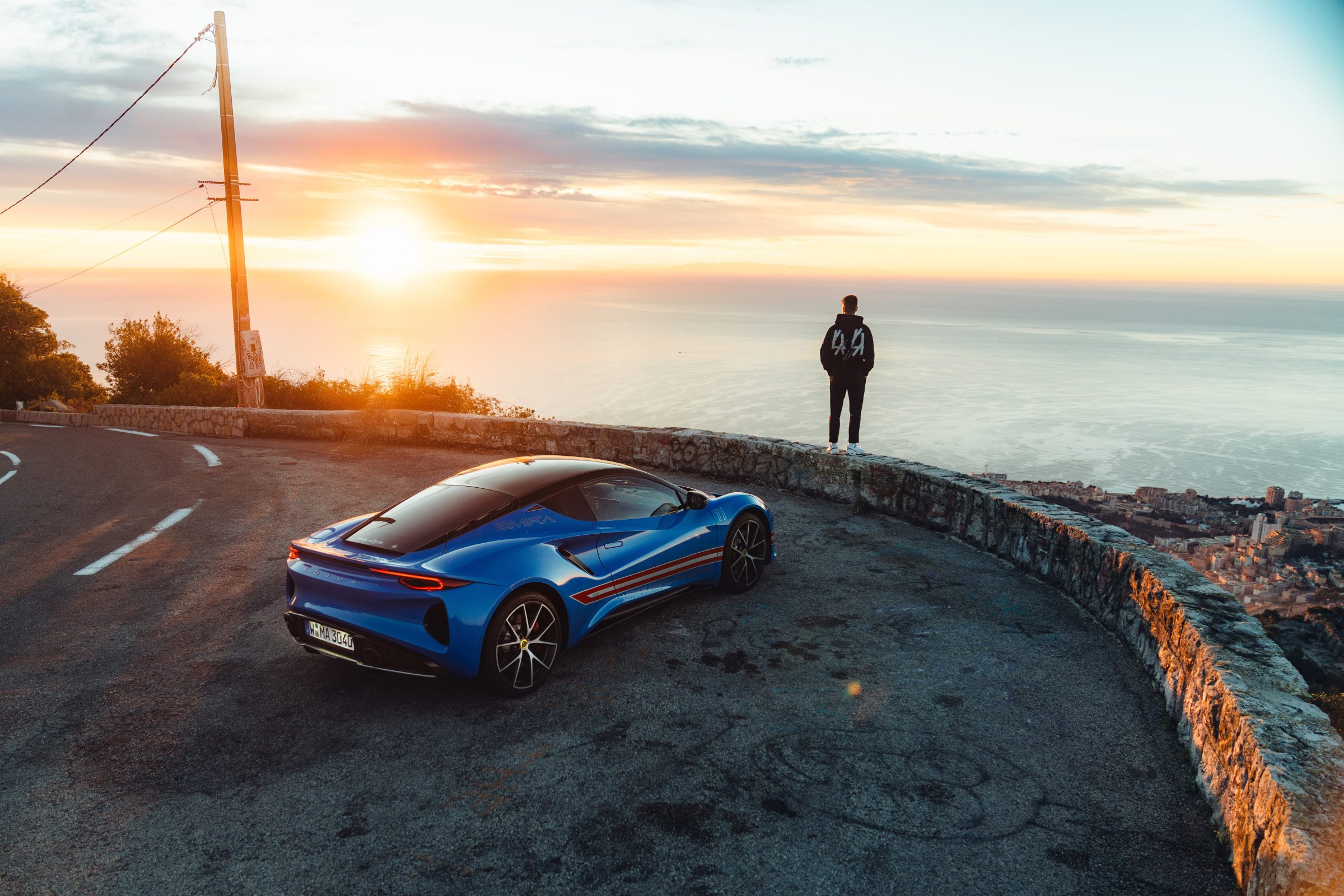
Forty-four years later, we stand on the Col de l’Arme and look down on the Principality of Monaco. The vehicle that brought us here is the Lotus Emira Type 86—a special edition limited to just 12 units, paying homage to that visionary prototype from the 1980s. Its history is immediately recognizable in the blue “Essex” paintwork with red and silver stripes and the number 11 on the fenders. As my fingers glide over the bodywork, I notice a detail that has become rare today: nothing here is wrapped in film. All accents are elaborately painted.
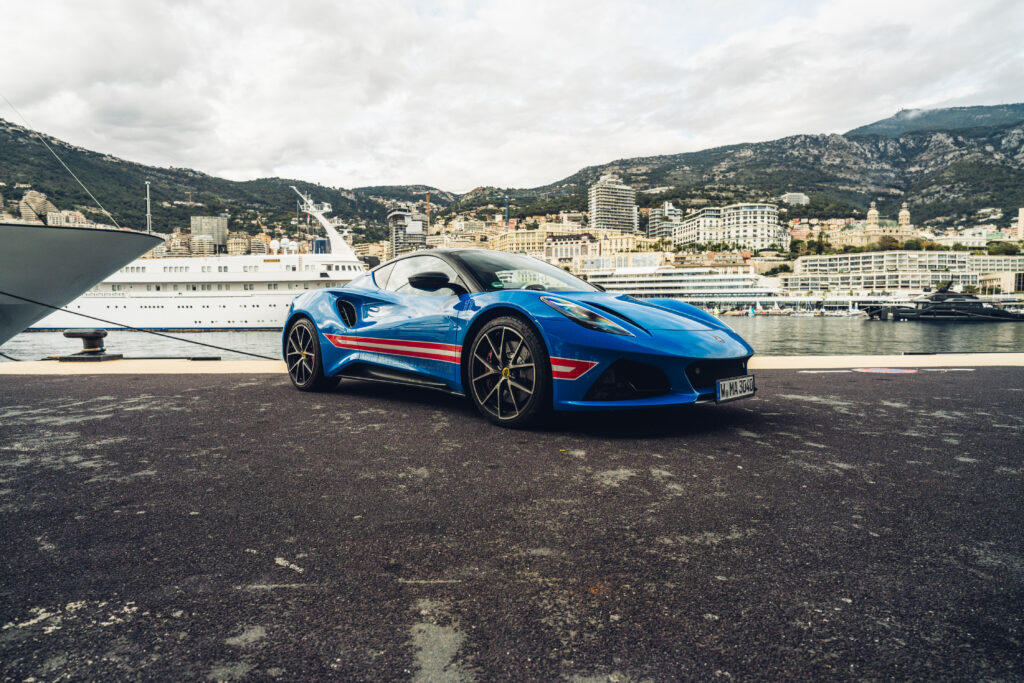
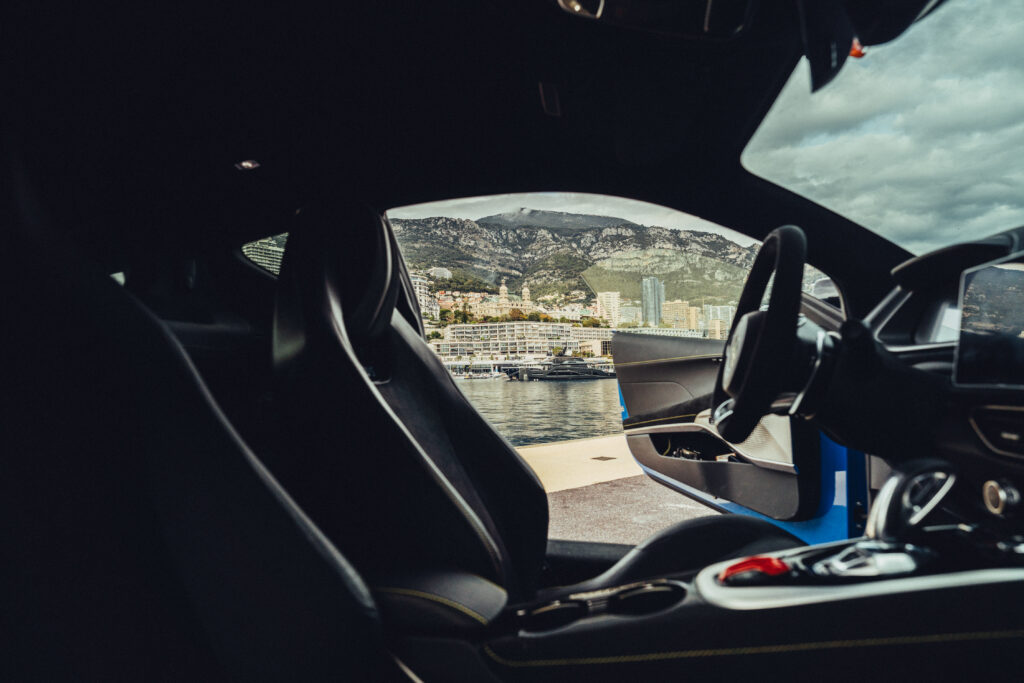

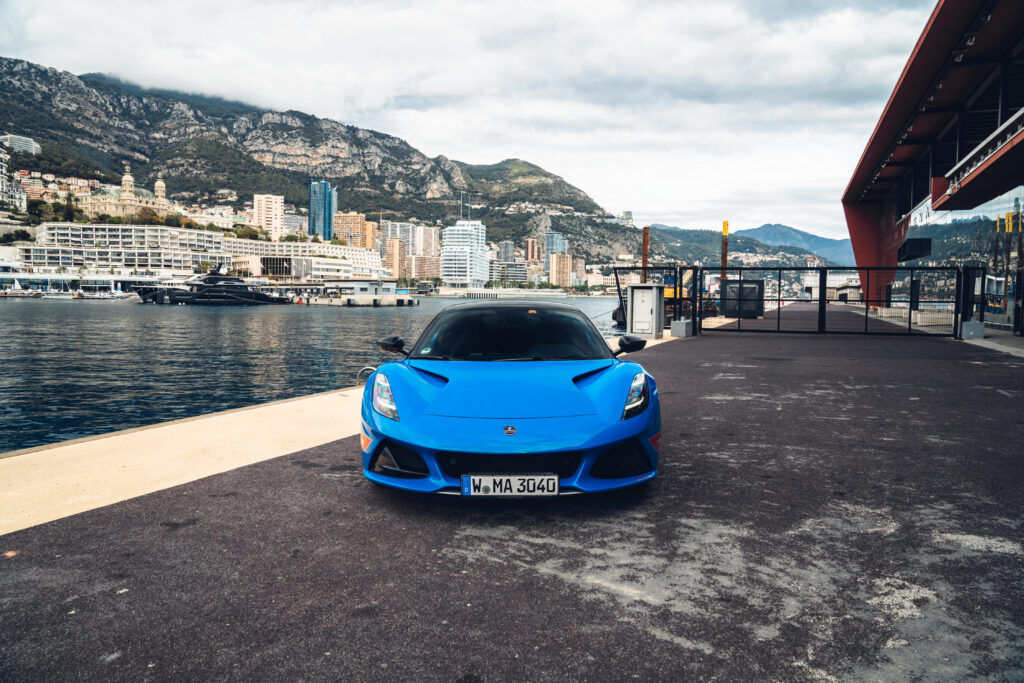
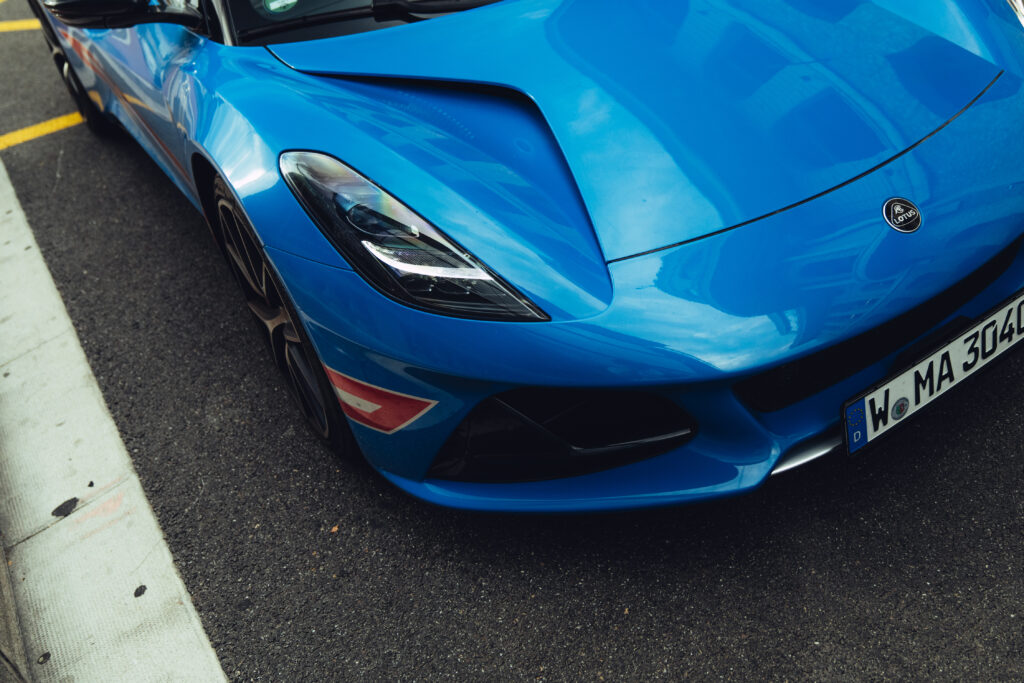
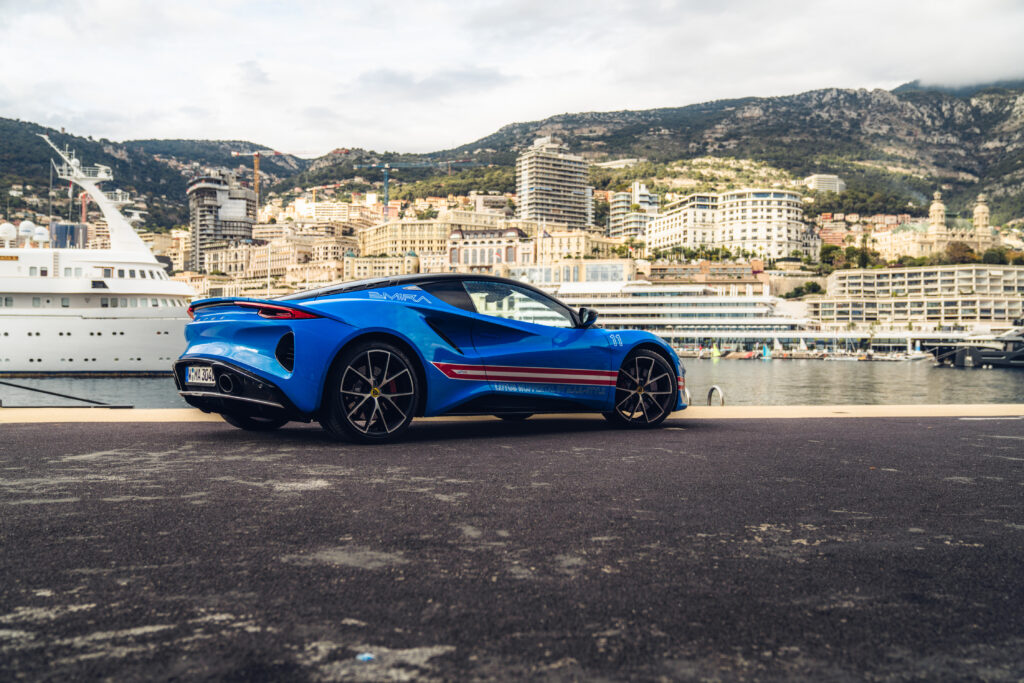
In the supercar–proven principality, countless heads turn to look at the Lotus. The reason for this is undoubtedly the design of the Emira, which unmistakably bears the DNA of the Evija electric hypercar. The striking front edge of the hood, the passenger compartment tapering toward the rear, and the sculptural rear end clearly reference its big brother.
As with the Evija, ventilation openings are integrated into the hood of the Emira. They efficiently direct airflow over the vehicle, optimize aerodynamics, and are virtually unique in this vehicle class. The vertical “twin-blade” design of the full-LED headlights has also been adopted from the Evija, giving the British car a modern presence without being obtrusive.
Technically, the Emira Type 86 remains deliberately purist. In our case, the familiar 2.0-liter four-cylinder engine from AMG works behind the seats, combined with an eight-speed dual-clutch transmission. The rear axle delivers 360 hp and 430 Newton meters of torque, enough to accelerate the Emira from 0 to 100 km/h in around 4.5 seconds. The top speed is just under 280 km/h. However, much more important than the bare figures is the basis: mid–engine layout, rear–wheel drive, a bonded aluminum structure, and a tightly tuned suspension that is consistently designed for feedback. With compact dimensions of around 4.41 meters in length and a low center of gravity, the Emira remains an old–school sports car, built not for spec sheets but for real roads, such as those in the mountains behind the Principality of Monaco.
Showdown: Col de L’Arme
Showdown! We leave the principality at nautical dusk. The route takes us up towards Tête de Chien, La Turbie, and finally to Col de l’Arme. The road winds its way up behind Monaco and ends at the prestigious Monte Carlo Golf Club. Four sharp hairpin bends are scattered along the route, interspersed with long curves and short straights. It is the home track of the Monegasques and probably one of the few places in the world where you can encounter Formula 1 drivers training in their hypercars with a golf bag on the passenger seat.
Behind the small village of La Turbie, the landscape opens up. Next to us, the mountain drops steeply into the Mediterranean Sea, and in the distance, the outlines of Corsica loom vaguely. A surreal moment. From here on, we speak to Emira for the first time in the language he understands best.
Here, far away from traffic jams, traffic lights, and stop-and-go traffic, the true nature of the British car unfolds. Brake, turn in, apex, throttle. In “Sport” and “Track” modes, the Emira dances nimbly out of the hairpin bends, agile and eager for the next corner. The English car’s steering response is almost telepathic. Due to the low steering return torque, it requires active work on the wheel after the apex. It doesn’t take long to find a rhythm with the Emira. Every corner, every load change feels like a well-conducted orchestra where everything just fits together.
“Four hairpins become twenty–four. Breakfast becomes more like brunch.”
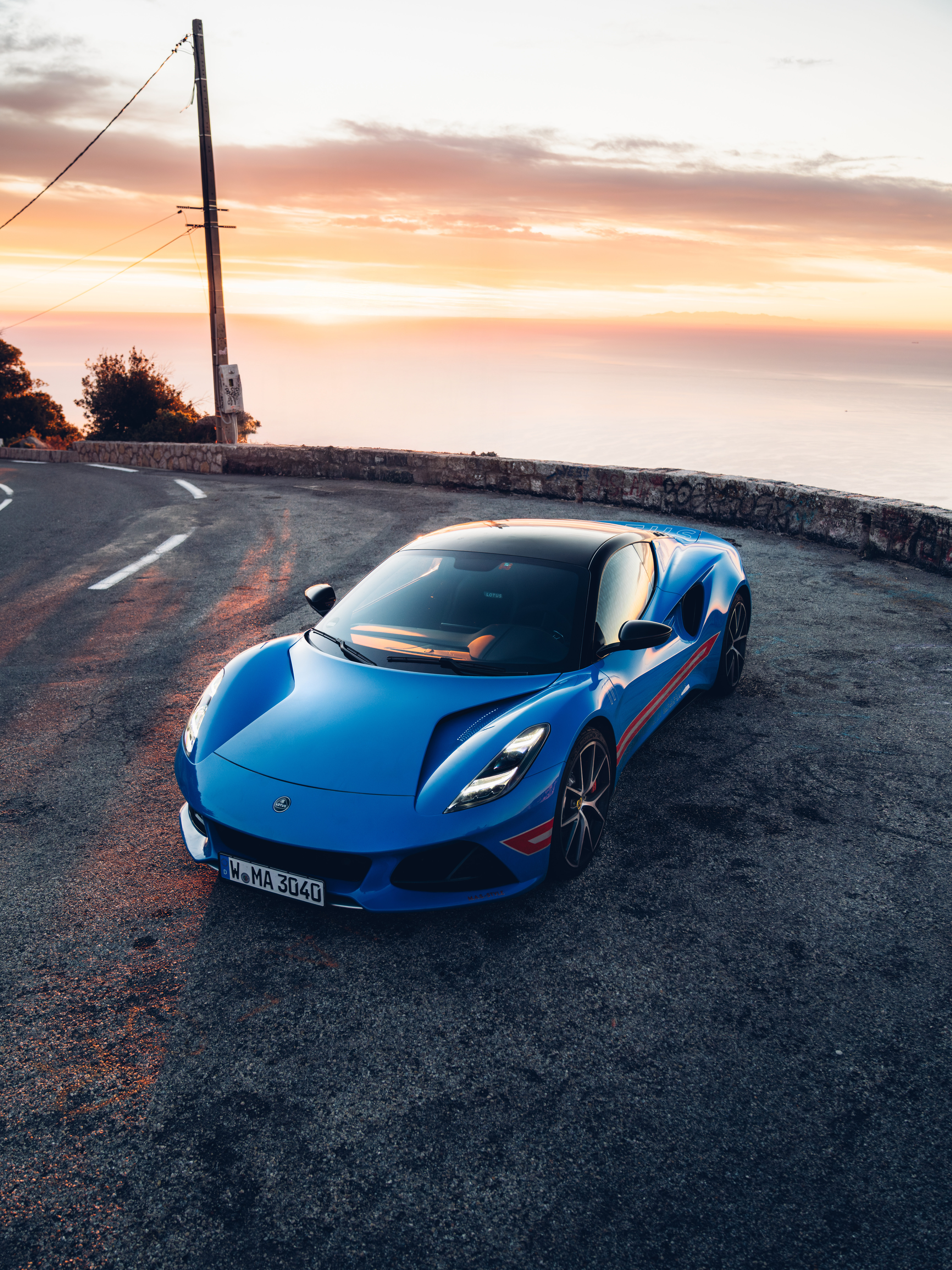
As we complete our third 180-degree turn at the summit of the Col, it becomes clear that the four hairpin bends have long since become many more. With this backdrop, a photo stop is a must, even though part of me would have liked to turn the 24 into 36 hairpin bends. Time to recap what has happened in the last 45 minutes. The first thought: this is exactly the car you need in this day and age. No autonomous driving, no hybrid complexity, no huge passenger display. No dull 0-to-100 acceleration monster.
Instead, we experience a pure sports car with an analog heart. And that’s despite the fact that the Emira doesn’t have a manual transmission, features conveniences such as cruise control, and confronts us with annoying touch controls on the steering wheel. But it offers just the right dose of those attributes that challenge and reward a driver: a rich sound, an excellent chassis, and steering that feels alive. Add to that a tidy interior where the air conditioning is still operated via physical buttons, which is wonderfully tactile. That’s exactly how it should be.
Back on the asphalt of the principality, it’s time to take stock: the Emira Type 86 impressively proves that even today, a sports car can still possess the virtues of yesteryear.
No overload, no technical bells and whistles, no distractions. Just the car, the road, and the driver. As corny as it may sound, the Emira is a true driver’s car that makes every turn tangible with feedback and character. And so, in the end, we are left with a silent thank you to Colin Chapman. His irrepressible engineering spirit and courage to push boundaries live on in this car. It’s a legacy that many leaders in today’s automotive industry would do well to emulate.

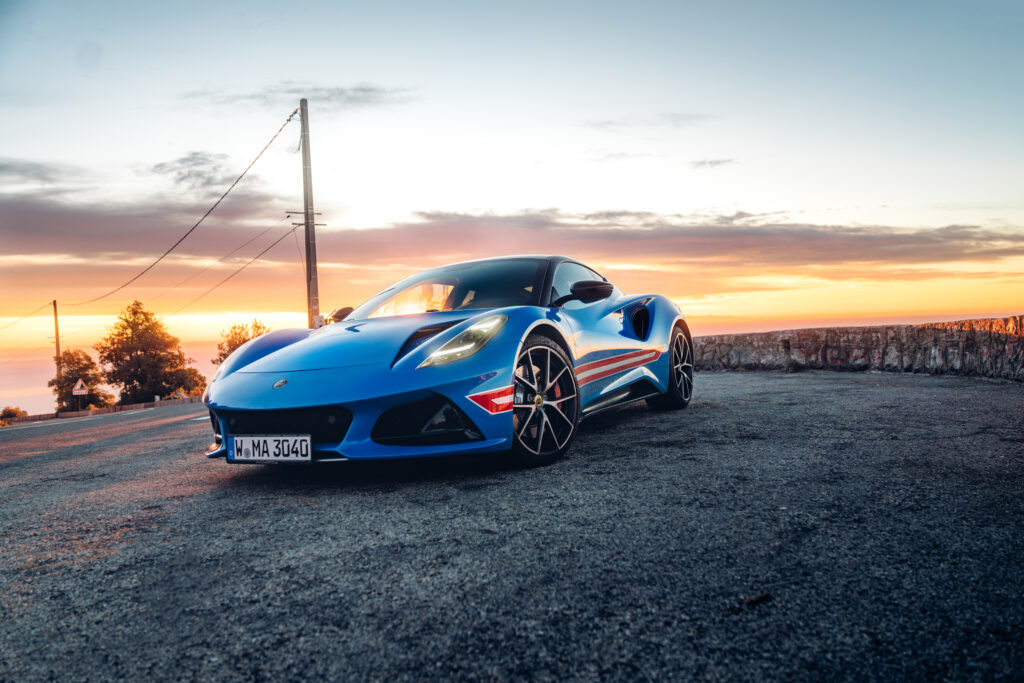
Lotus Emira Type 86
Engine: 2,0-Liter 4 Cylinder Engine from AMG
Power: 360 HP @ 6.600 U/min
Weight: ca. 1.405 kg
Acceleration: 0–100 km/h in 4,4 seconds
Max. torque: 430 Nm.
V-Max: 275 km/h